- The history and tradition of tea scenting in Vietnam
- The ingredients
- The techniques
- Preparing and enjoying lotus tea
- References
Among the many teas Vietnam produces, lotus-scented tea — trà sen — holds a particular place. It is not a cultivar but a finished tea, made to carry the fragrance of the lotus flower. It is also one of the most labour-intensive and most debated teas in the country, and in 2024 the craft behind it was added to Vietnam’s national list of intangible cultural heritage. This article traces where the tradition comes from, what goes into the cup, the four main ways the scent is fixed into the leaf, and how to brew the result so the work behind it is not wasted.
The history and tradition of tea scenting in Vietnam
Vietnamese tea is usually grouped into three broad families: fresh-leaf tea (trà tươi), plain dried tea (trà mạn), and scented tea (trà hương). Of the three, scented tea is often considered the most distinctive expression of Vietnamese tea-making, reflecting a long-standing attention to fine ingredients and patient, handmade craft [1].
The practice draws on a small group of flowers prized for how readily they give up their scent: lotus, jasmine, chrysanthemum, ngâu (Aglaia odorata), sói (Chloranthus), mộc (osmanthus) [2], and pomelo flower (hoa bưởi) [3]. Within this group there is a rough order of prestige, with lotus at the top and osmanthus second [2][3].
How far back the lotus version goes is uncertain. Different writers trace it to the Lý, Lê, or Nguyễn dynasties, or to the eighteenth and nineteenth centuries, usually without primary evidence [3][5]. What can be documented is that by the turn of the nineteenth century the custom was established enough to be written down: the scholar Phạm Đình Hổ (1768–1839) described contemporary tea-drinking habits, including the scenting of tea with flowers, in his essay collection Vũ trung tùy bút (Essays Written During the Rain) [6][7]. The tea carried associations with royal tribute and with the culture of scholars and the literati, and the West Lake version earned a much-repeated nickname: Thiên cổ đệ nhất trà, “the greatest tea from time immemorial” [1][3].
In August 2024, the Ministry of Culture, Sports and Tourism added the lotus-tea scenting craft of Quảng An ward, in Hanoi’s Tây Hồ (West Lake) district, to the national list of intangible cultural heritage [8][9].
The ingredients
Two choices define a lotus tea before any scenting begins: the tea that will form the base, and the lotus that will give the scent.
The base tea
Trung Du cultivar
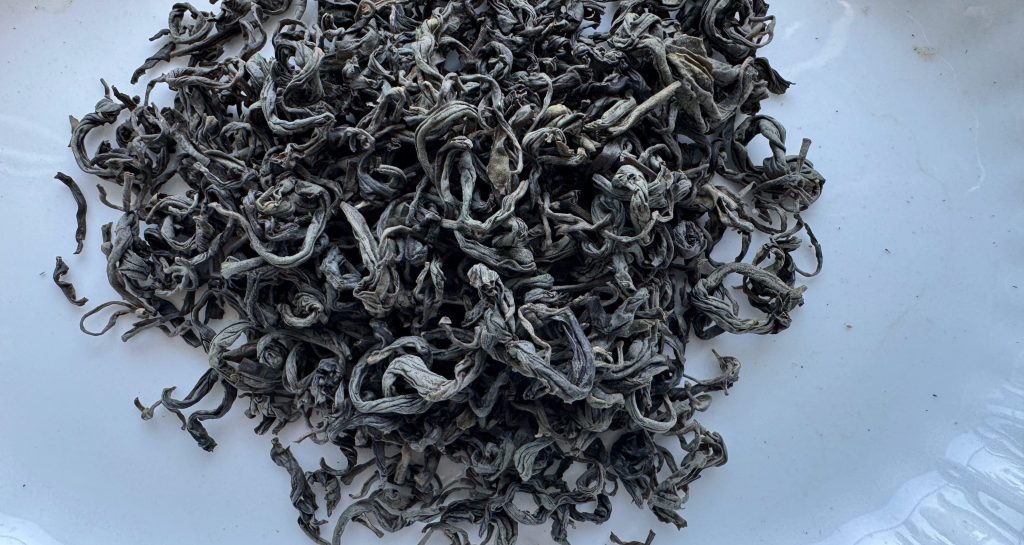
The most common base for scenting is a green tea of the Trung Du cultivar, the long-established native variety of Thái Nguyên province and, in particular, the Tân Cương growing area [10][31]. It is the conventional — and in most accounts the “safe” — base, the one that best expresses the traditional northern style of lotus tea [10]. Its small, tightly curled leaf holds the fine lotus pollen well during scenting, which helps the fragrance last [10]. The tea itself carries a young-rice or cốm aroma with a bold tannic quality that quickly turns into a sweet aftertaste lingering deep in the throat. To my taste, it also has a savoury, almost umami-like quality.
Snow Shan cultivar
An alternative is Shan tuyết (snow Shan), tea from old mountain trees of the broad-leaf variety Camellia sinensis var. assamica. These trees grow at altitude in provinces such as Hà Giang and at Suối Giàng in Yên Bái; their leaves are larger, thicker, and stronger in flavour, with a depth of sweetness that survives several infusions [11]. Using snow Shan as a scenting base involves a trade-off: the larger leaf takes the fragrance less readily and needs more lotus to scent, and it holds more moisture, so it has to be turned and re-mixed with the lotus more often to keep it from spoiling [11][12][13]. The reward is endurance — a well-made Shan tuyết lotus tea can be brewed five or six times and still hold its scent, where a lighter base fades sooner [14].
Aged, not fresh
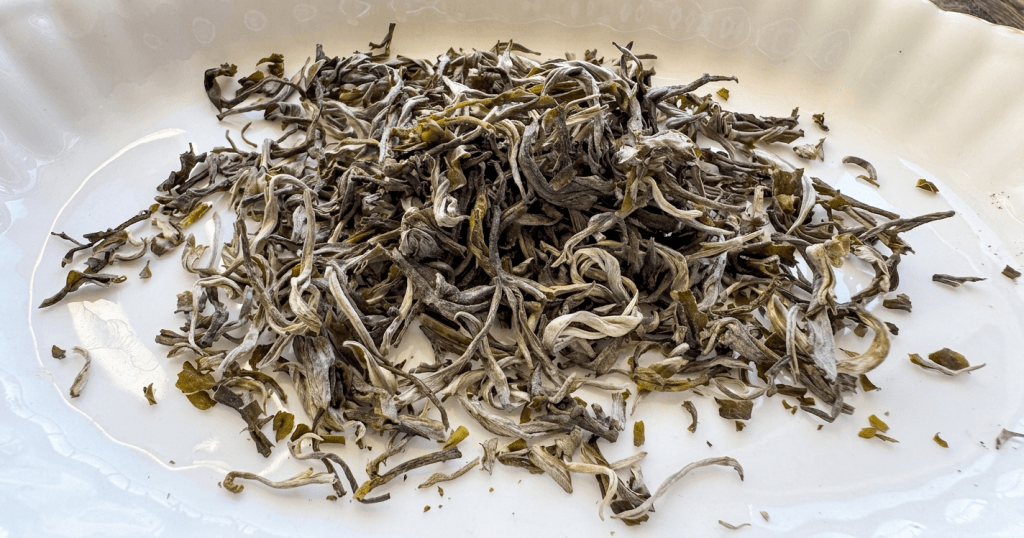
Whichever cultivar is chosen, the base should not be tea that has just come off the pan. Traditionally, the leaf was rested for years before it ever met a lotus. The classical Hanoi scenting base was tea stored in earthenware jars under a layer of dried banana leaves and left for three to four years before use, long enough that batches were always marked with their year of production. The waiting weathers off much of the raw astringency, clears the green, grassy note of new tea, which would otherwise compete with the lotus rather than carry it, and leaves the leaf dry and porous, the texture of blotting paper. A porous leaf can draw in the lotus’s moisture and oils over repeated scentings. Fresh tea, still tight and still loud with its own character, takes the scent less readily and then argues with it, which makes scenting it a waste of both the leaf and the many hundreds of flowers it consumes.
The lotus
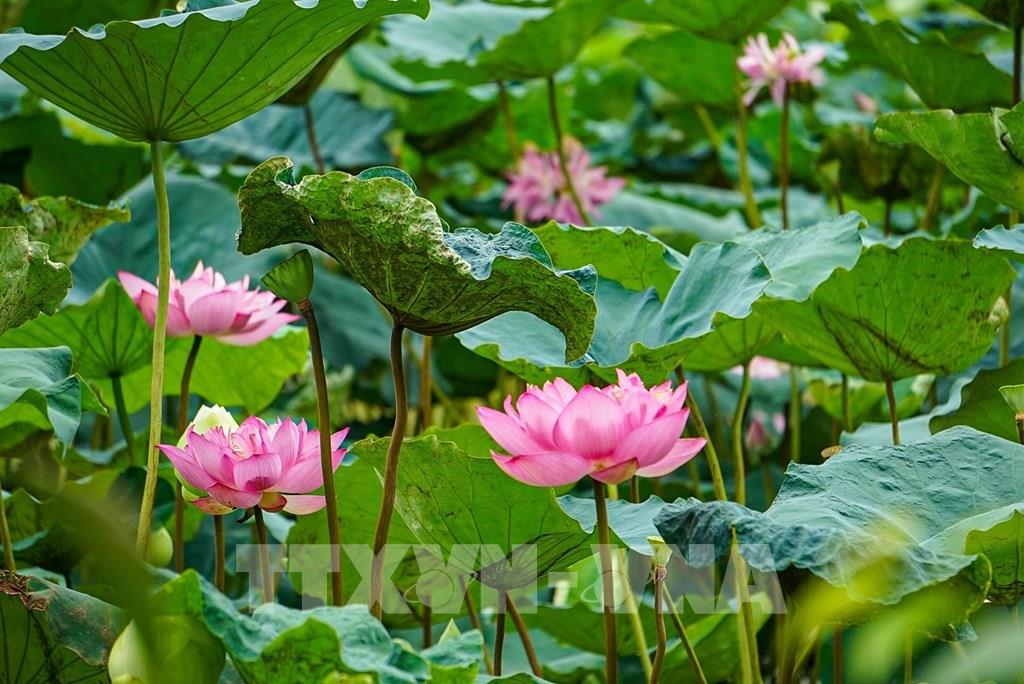
The two most popular cultivars are the Bách Diệp and the White Lotus, each prized for its own aromatic and taste profile. The Bách Diệp — the name means “hundred petals” — is a pink, many-petalled lotus native to the West Lake area of Hanoi, and gives a bold, long-lasting scent [32].
The White Lotus (bạch liên) of Tịnh Tâm Lake in Huế, an imperial-garden flower once used in Nguyễn court tribute tea and revived from near-loss around 2020–2021, is subtler and more delicate [17][18][19].
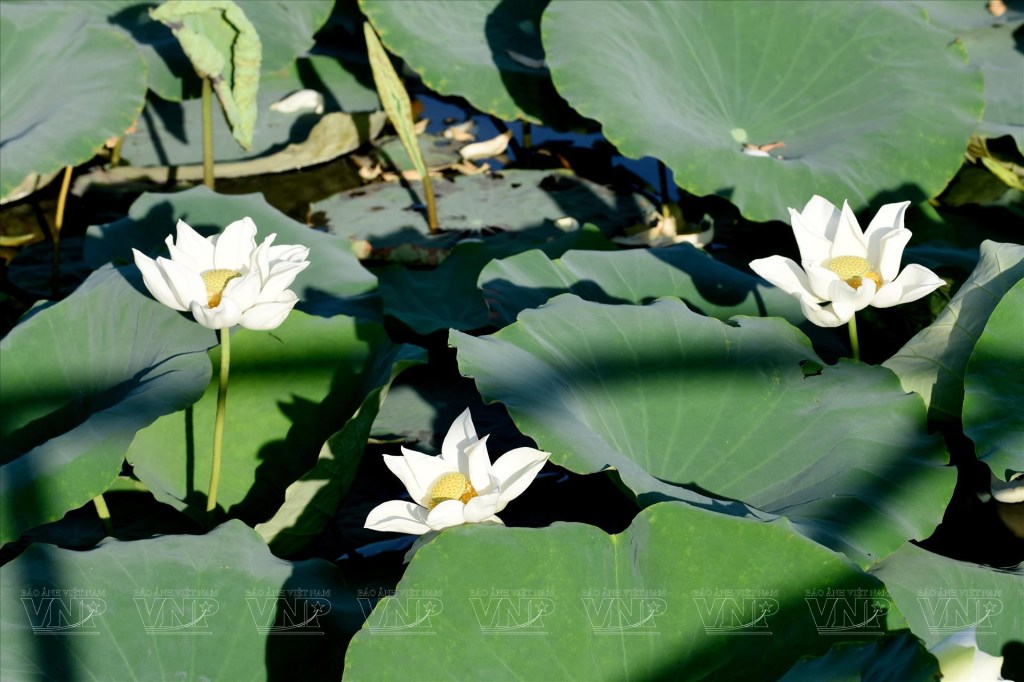
Both are forms of the same species, Nelumbo nucifera. In either case, the scent is carried not by the petals but by the gạo sen, or “lotus rice”: the tiny, pale, rice-like grains at the tips of the stamens, which are layered with the leaf in the most traditional method [1][8].
A word on the “West Lake” label: most sellers call the northern tea Trà Sen Tây Hồ, “West Lake lotus tea”, but the name is now more branding than provenance. The Bách Diệp takes its association from the lake, where it was long grown, yet urbanisation and pollution have shrunk the lake’s lotus ponds, and the flowers used for scenting now largely come from cultivation elsewhere [8][34]. It is worth asking where the lotus was actually grown, rather than trusting the name.
The techniques
The lotus scent reaches the leaf in four main ways. They differ sharply in cost, labour, and what they preserve — and telling them apart is the single most useful thing a buyer can learn.
Fresh-flower scenting (ướp xổi)
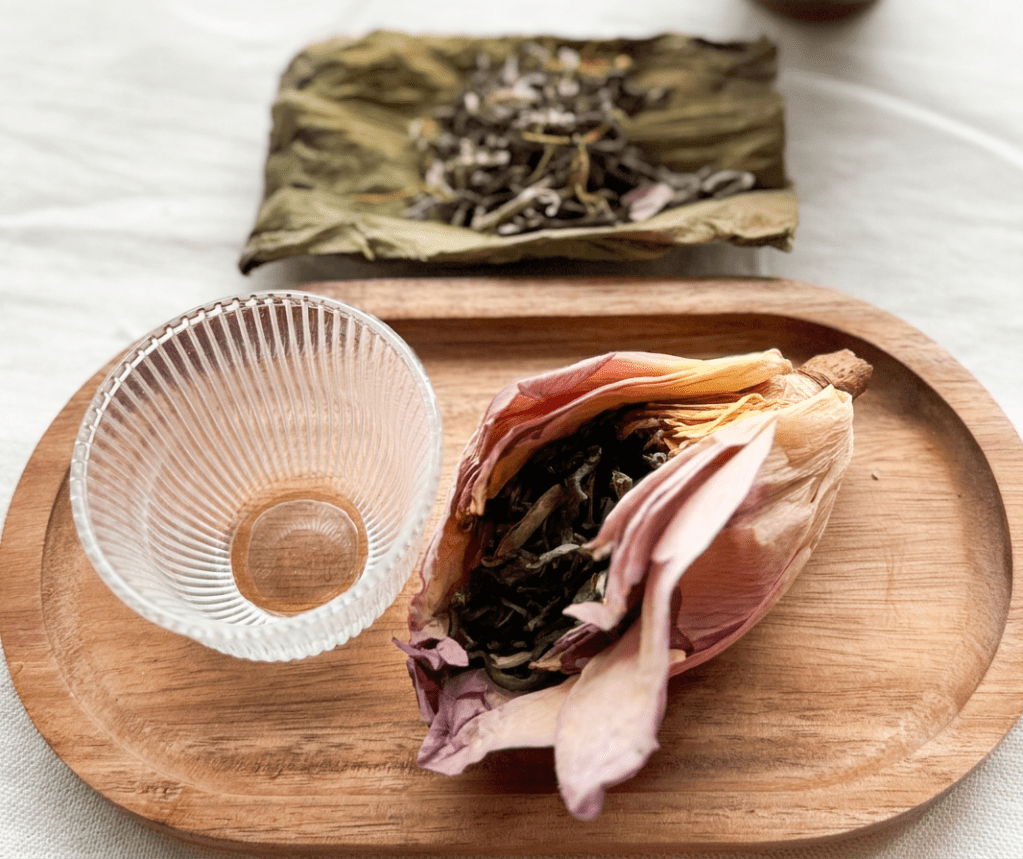
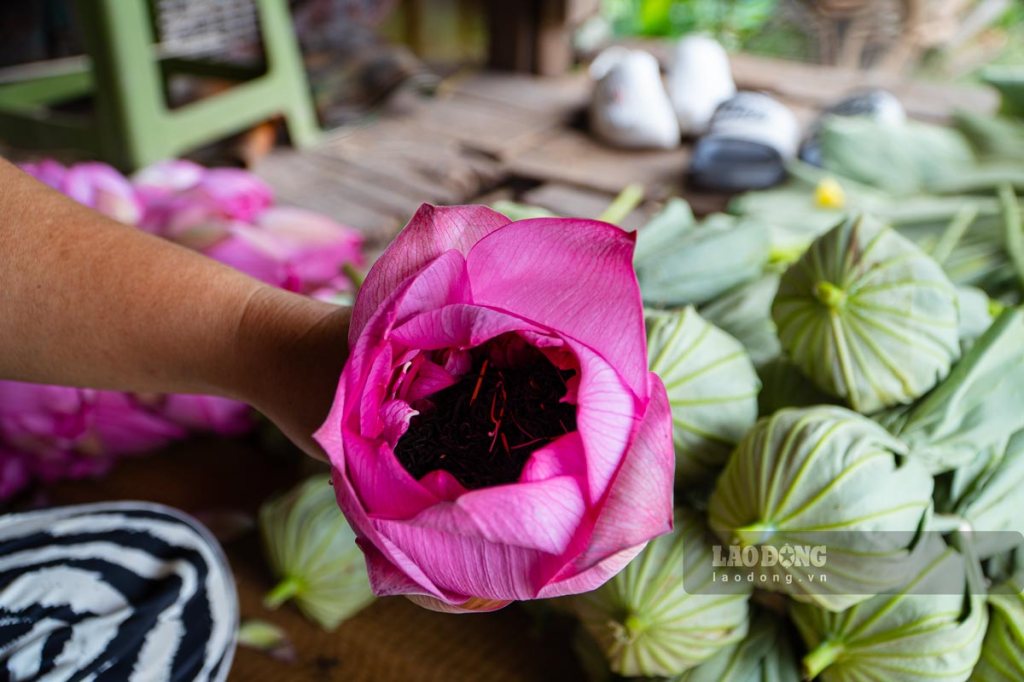
In fresh-flower scenting, dried tea is packed directly inside a freshly cut lotus bloom — about 15 grams of leaf per flower. The petals are folded back over the tea and tied shut with a thin strip of soaked bamboo, and the whole flower is often wrapped in a lotus leaf to keep the scent from escaping [8]. The bloom is then left, usually overnight, to pass its fragrance to the leaf.
A related approach is to pack the tea directly inside the bloom while it is still attached to the stem, left overnight to weave the scent in, and harvested the following morning.
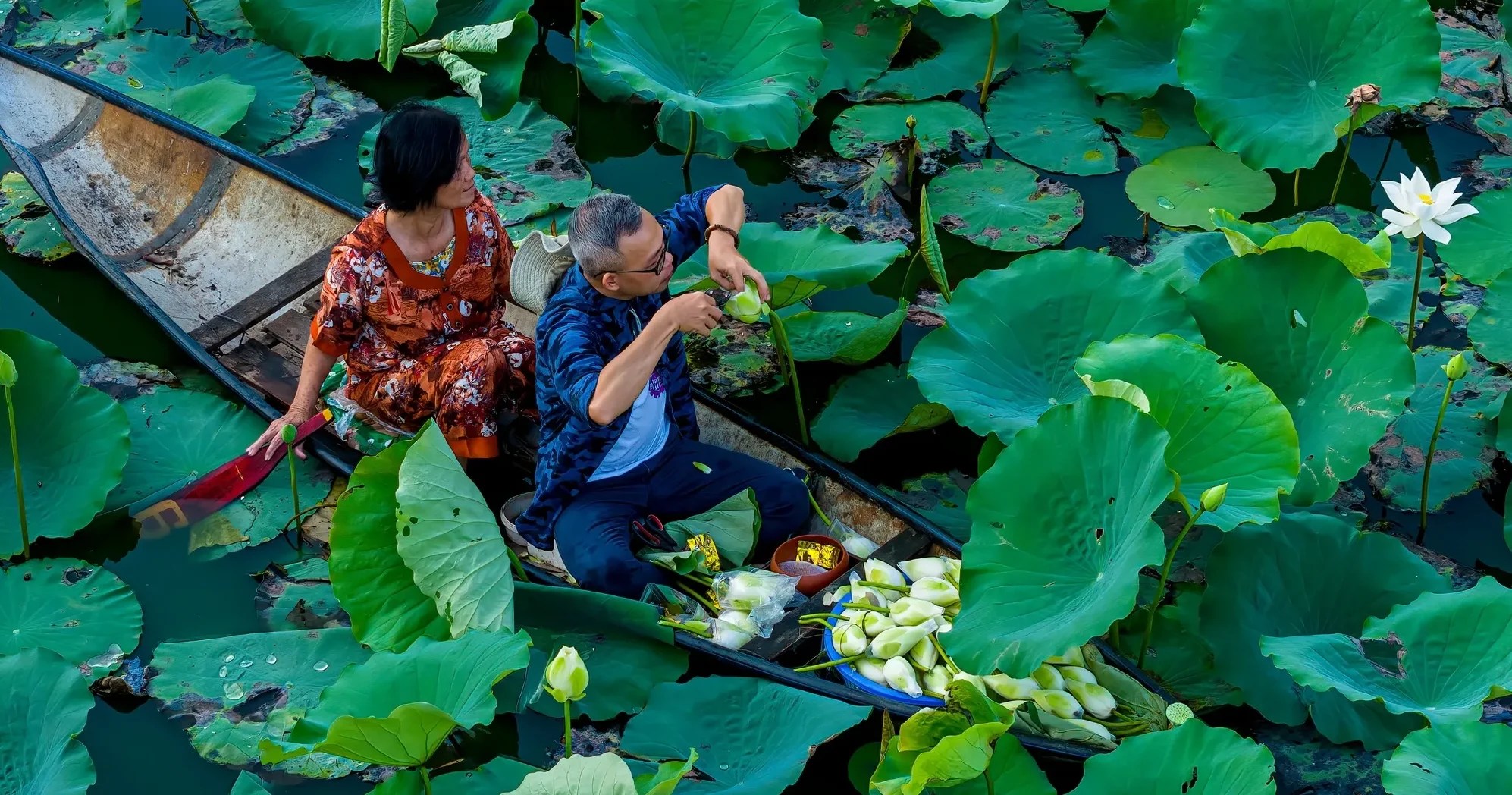
This is the simplest of all the methods, but it does not keep. Because the flower is fresh, the tea must be used soon; left too long, the damp leaf ferments and spoils [16]. Its appeal is immediacy, and the bloom itself makes a striking object — one reason it has gradually become the more common product in Quảng An, displacing the far more demanding dry-scented style [8].
That same perishability makes fresh-flower tea hard to transport. To hold its taste and scent over any distance, it must be kept frozen [8]; once defrosted, it should be drunk almost at once, or refrigerated and used within about two days. The traditionally scented and freeze-dried versions are far more practical for most drinkers, since both are stable and keep for months or more.
Traditional stamen layering (ướp truyền thống)
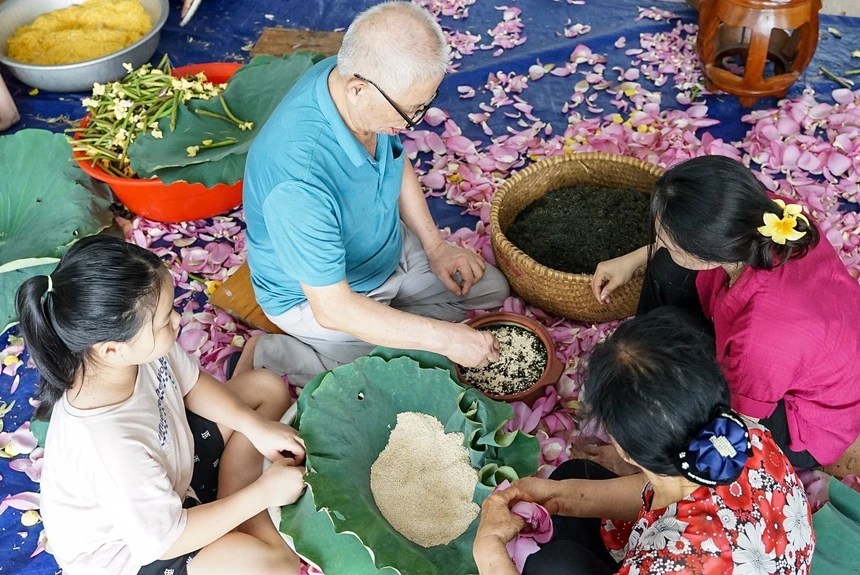
The traditional dry-scented method is the one tied to the “greatest tea from time immemorial” name, and the one the heritage listing was built around. Tea is layered with lotus anthers (also called “rice” in Vietnamese) — a layer of grains to a layer of leaf — then rested so the leaves draw in the scent, then separated, dried, and scented again. This cycle is repeated about seven times, roughly twenty-one steps in all, and the whole process takes around fifteen to twenty-one days [8][16]. It takes roughly 1,000 to 1,300 blooms to make one kilogram of finished tea [8][16][20].
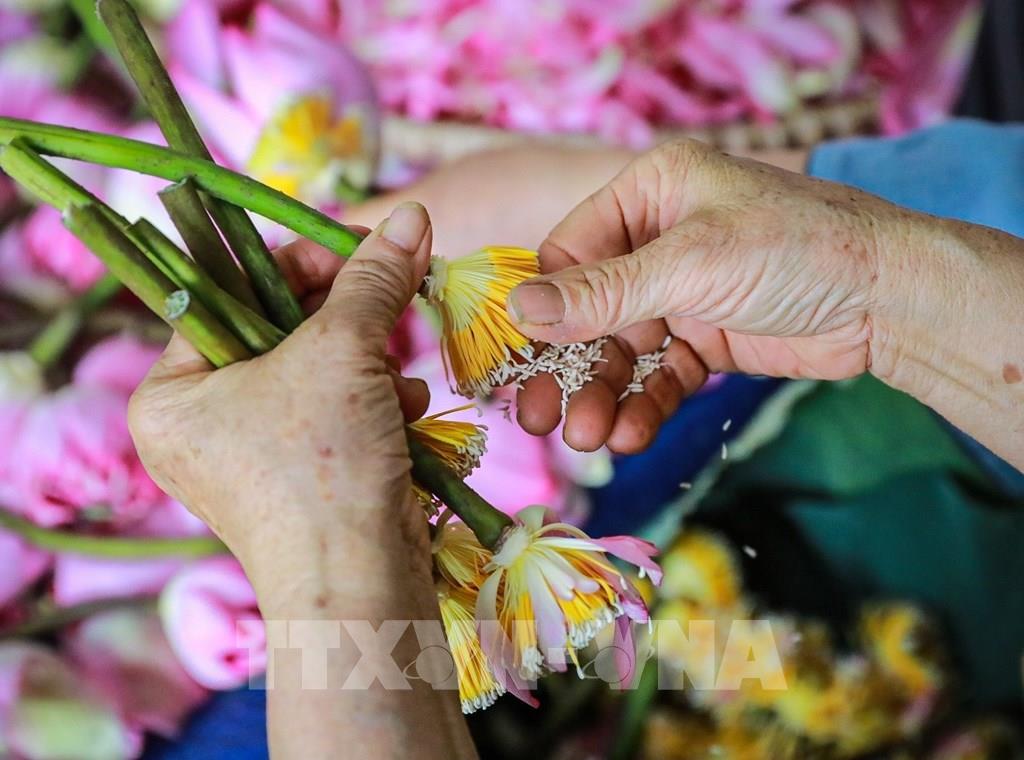
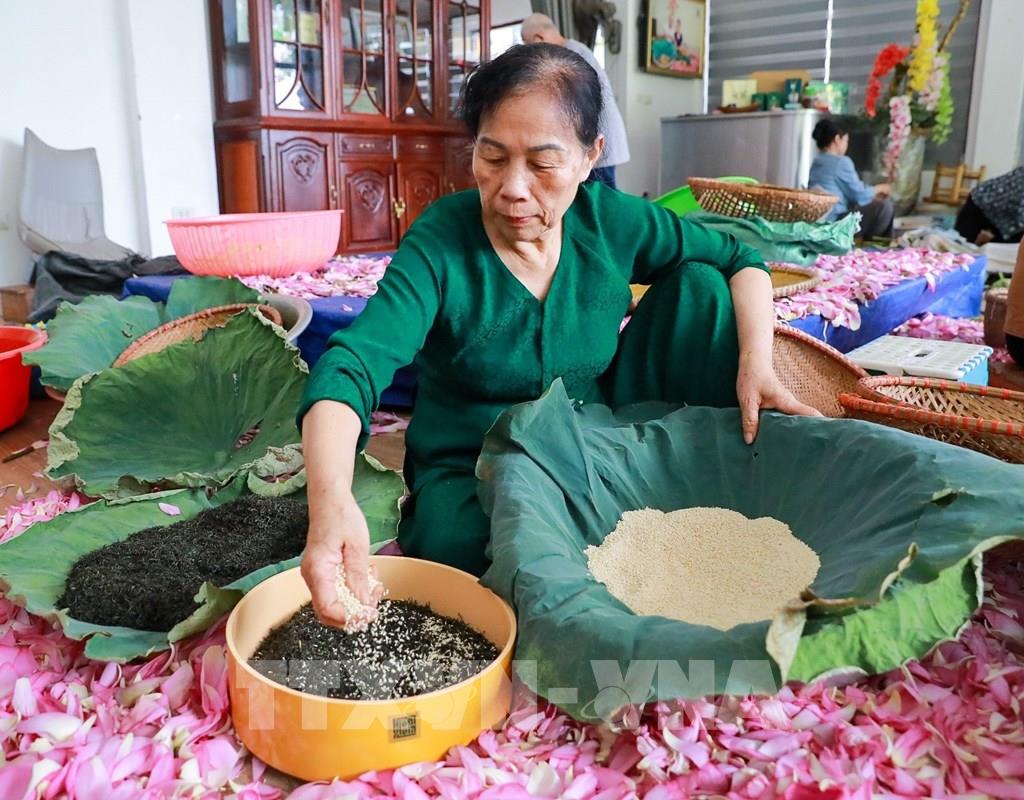
The repetition is not only about building up scent; it is also a balancing act. Each cycle must drive the lotus’s moisture and aromatic oils into the dry, porous leaf without leaving it damp enough to oxidise or spoil — which is why the tea is dried again between scentings rather than simply left to sit [8]. The work is exacting throughout: flowers are picked between about four and six in the morning, while they are still half-open — the state makers call hàm tiếu, “half-smile” — because that is when the scent is fullest [8]. The cleanest result uses lotus rice alone; adding the small inner petals is cheaper but coarsens the fragrance [8].
Some records mention an even older technique, using compressed tea from Hà Giang — close to a pressed dark tea — steamed to loosen the leaf, layered with lotus rice in a metal pot, held at around 25–28°C for two to three days, then dried over charcoal or by steam [8]. The charcoal route is prized but loses scent easily and demands real skill, part of why the dry-scented craft now survives in only a handful of families [8]. I have never tried it myself, as it is incredibly rare.
Of all the techniques, traditional stamen layering produces the most intense scent, with surprising durability — I have found the fragrance still lingers into the seventh infusion, long after the taste itself has faded.
Freeze-dry scenting (ướp bông sấy thăng hoa)
Freeze-dry scenting is a modern answer to the perishability of fresh-flower tea. After a whole flower is scented, it is freeze-dried, drawing off the moisture at very low temperature and pressure so that the aromatic compounds survive intact [8][21]. The fragrance stays close to how it was at picking, and the sealed flower keeps for a year or more, which also makes it practical to carry abroad [8].
The trade-offs are cost and tradition: freeze-drying requires equipment and sells at a clear premium [8]. For the drinker, the real question is simply whether the flower and leaf were good and well-scented to begin with — freeze-drying preserves what is there, but it cannot rescue a weak scenting. As ever, it comes down to good flowers and tea, picked at the right time and scented with care.
There are around a dozen lotus-scenting artisans in the greater Hanoi area, and each has their own philosophy, technique, and closely guarded method [8]. Some treat the tea as the central character and the lotus fragrance as the enhancer; others prefer to let the lotus lead. This shapes their tea-to-lotus-grain ratio, their scenting time, and their layering technique. Personally, as a tea fanatic, I like it when there is more tea than lotus — though for those more sensitive to the taste of the tea itself, a lotus-forward style may be the better choice.
Synthetic scenting (ướp hương liệu)
The fourth method is not a craft but a substitution. In synthetic scenting, a cheaper or lower-grade tea is dosed with manufactured lotus flavouring or essence instead of real flowers [18][22]. It is far cheaper to produce and makes up much of the inexpensive “lotus tea” on the market.
Genuinely scented leaf looks dull — dark green to greyish — because it has taken up moisture from the lotus rice during resting, and small pale grains of lotus rice are usually visible through it; the scent is soft, pure, and lingering [23][24]. Synthetically treated tea tends to have an evenly dark colour and smells sharper or more pungent [23][24]. Price is another signal: tea woven with real flowers is expensive to make and priced accordingly, so a very cheap “lotus tea” is a reason for caution rather than a bargain [25]. Beyond value, synthetic flavouring adds nothing to — and may detract from — the qualities people drink green tea for in the first place [22].
Preparing and enjoying lotus tea
A good lotus tea benefits from a gentle hand. The aim is to coax out the scent, not to extract maximum strength, so restraint matters more here than with plain tea.
Water temperature
Water should be hot but not boiling — typically 80–90°C, using freshly boiled water left to cool for a short while. Water that is too hot scalds the leaf and pushes the cup towards harshness, which buries the lotus [26]. On a temperature-controlled kettle, the “Green Tea” setting is a safe choice. I personally prefer the 80°C mark, as anything hotter makes it harder for me to fully taste the tea.
Ratio and timing
I use a ratio of about 5g of leaf to 100–120ml of water, enough for a single-person session. For freshly scented or freeze-dried tea sold with the flower intact, you can also add the anthers, stamens, and petals to enjoy the whole bloom — though including the rice and stamens will bring a touch of bitterness.
I skip the quick rinse: the first infusion holds the most fragrance, and rinsing simply washes it away. A short infusion — within about thirty seconds — keeps the liquor bright and stops the scent from turning heavy.
A Trung Du lotus tea gives me around three really good infusions before the scent and flavour begin to fade, though I tend to prefer a stronger cup, so that is partly a matter of personal style. The snow Shan version can be brewed five to six times, releasing its flavour more slowly. It is less striking at first than Trung Du, but comes fully into its own by the second infusion — I enjoy both, but lean towards the Shan for its staying power.
Teapot and vessels
This comes down to personal preference. Many Vietnamese drinkers favour an unglazed clay pot — Yixing zisha from China, or the red clay of Bát Tràng in Vietnam. The porous clay holds heat steadily and slowly takes on the tea’s aroma, which suits a fragrance-led tea [22][30]; because it absorbs scent, a clay pot is usually kept for scented tea alone, so flavours do not mingle [30].
For lotus tea, I prefer fine porcelain or ceramics. I find a clay pot’s heat retention a little overpowering for so delicate a scent, whereas porcelain or ceramic sheds heat faster, lowering the risk of over-steeping — which yields a harsh, astringent cup as more of the leaf’s catechins are drawn out. Being non-porous, ceramic or porcelain holds no flavour of its own, making it a versatile vessel for tasting and experimenting. I am also fond of the Japanese shiboridashi, whose wide mouth shows off the leaves and whose non-porous surface offers the same flexibility. Glass teaware is another good option, letting me take in the colour, shape, and petals as the tea brews — more an aesthetic pleasure than a question of taste, but part of the enjoyment all the same.
For all the ceremony that surrounds it, lotus tea comes down to a simple idea carried out with great patience: a clean leaf, a flower picked at the right hour, and a method chosen to match how you mean to drink it. Knowing which of those methods is in front of you — and brewing it with a gentle hand — is most of what it takes to drink it well.
References
- Lotus tea. Wikipedia (English). https://en.wikipedia.org/wiki/Lotus_tea
- Trà hương — Thức uống mỹ vị của người Việt. VietnamPlus (Mega). https://mega.vietnamplus.vn/tra-huong-thuc-uong-my-vi-cua-nguoi-viet-6745.html
- Trà ướp hoa — Tinh hoa văn hóa trà Việt. Hùng Mộc Trà. https://hungmoctra.vn/tra-uop-hoa-tinh-hoa-van-hoa-tra-viet.html
- Nét độc đáo trong văn hóa trà Việt qua các loại trà hương — trà tẩm ướp. Hải Thuỵ. https://haithuy.vn/net-doc-dao-trong-van-hoa-tra-viet-qua-cac-loai-tra-huong/
- Khám phá lịch sử và nguồn gốc của trà sen trong văn hóa Việt. Travina / HTX Tâm Trà Việt. https://htxtamtraviet.com/kham-pha-lich-su-va-nguon-goc-cua-tra-sen/
- Phạm Đình Hổ — học giả, nhà văn viết ký sự tài. Người Hà Nội. https://nguoihanoi.vn/pham-dinh-ho-hoc-gia-nha-van-viet-ky-su-tai-79504.html
- Vũ trung tùy bút. Wikisource (Vietnamese). https://vi.wikisource.org/wiki/V%C5%A9_trung_t%C3%B9y_b%C3%BAt
- Vì sao nghề ướp trà sen Quảng An trở thành di sản văn hóa phi vật thể? VietnamPlus, 13 August 2024. https://www.vietnamplus.vn/vi-sao-nghe-uop-tra-sen-quang-an-tro-thanh-di-san-van-hoa-phi-vat-the-post970024.vnp
- Hanoi lotus-scented tea making craft listed among national intangible cultural heritage. VietnamPlus (English), 15 August 2024. https://en.vietnamplus.vn/hanoi-lotus-scented-tea-making-craft-listed-among-national-intangible-cultural-heritage-post291888.vnp
- Có nên sử dụng trà Shan Tuyết thay cho trà Thái Nguyên để làm trà sen Tây Hồ? Tân Cương Xanh. https://tancuongxanh.vn/co-nen-su-dung-tra-shan-tuyet-thay-cho-tra-thai-nguyen-de-lam-tra-sen-tay-ho
- 9X cất bằng kỹ sư, về quê làm trà cổ thụ ướp sen. Báo Dân trí. https://dantri.com.vn/van-hoa/9x-cat-bang-ky-su-ve-que-lam-tra-co-thu-uop-sen-20210603215330140.htm
- Người “nâng tầm” cho trà sen bay cao, vươn xa. Báo Công Thương. https://kinhte.congthuong.vn/nguoi-nang-tam-cho-tra-sen-bay-cao-vuon-xa-259457.html
- Trà Shan Tuyết Cổ Thụ Ướp Sen Sấy Thăng Hoa. Trà Cổ Thụ Shan Hoa. https://tracothu.vn/san-pham/tra-shan-tuyet-co-thu-uop-sen-say-thang-hoa/
- Tháng 6 về làm trà shan tuyết ướp hoa sen. Tôi Yêu Trà. https://toiyeutra.vn/thang-6-ve-lam-tra-shan-tuyet-uop-hoa-sen.html
- Trà Thái Nguyên ướp Hoa Sen. Thượng Đẳng Danh Trà. https://thuongdangdanhtra.com/tra-uop-sen-loai-ngon-100g
- Trà xanh ướp gạo sen Sơn Tiệm Sen — Shan Tuyết cổ thụ Việt Nam. An Viên Trà. https://daylaanvientra.com/vi/tra-xanh-uop-gao-sen-son-tiem-sen-shan-tuyet-co-thu-viet-nam
- Thức dậy sắc hương sen cổ trắng Huế trên hồ Tịnh Tâm. Báo Pháp luật Việt Nam. https://baophapluat.vn/thuc-day-sac-huong-sen-co-trang-hue-tren-ho-tinh-tam-post396291.html
- Tịnh Tâm bạch liên trà. Hữu cơ Huế Việt. https://huucohueviet.vn/tinh-tam-bach-lien-tra/
- Sen trắng Tịnh Tâm vào mùa. Nông thôn Việt. https://nongthonviet.vn/sen-trang-tinh-tam-vao-mua-45205.html
- Các loại Trà Sen Tây Hồ ướp Chè Tân Cương Thái Nguyên. Trà Thái Nguyên. https://www.trathainguyen.net.vn/cac-loai-tra-sen-tay-ho-uop-che-tan-cuong-thai-nguyen-bid670.html
- Tổng quan quy trình công nghệ trà ướp hương hoa của Việt Nam. FoodNK. https://www.foodnk.com/tong-quan-quy-trinh-cong-nghe-tra-uop-huong-hoa-cua-viet-nam.html
- Trà Sen — Cách Ướp Và Những Điều Cần Biết. Vitas. https://vitas.org.vn/cay-che/tra-sen.html
- Cách pha và phân biệt trà sen Tây Hồ chuẩn. Diễn đàn Kế toán. https://forumketoan.com/threads/cach-pha-va-phan-biet-tra-sen-tay-ho-chuan.97913/
- Mua Trà Ướp Sen Ở Đâu? Vitas. https://vitas.org.vn/vi/blog/mua-tra-uop-sen-o-dau.html
- Chọn Trà Sen Đúng Điệu — Nghệ Thuật Tránh Hàng Giả. Thuận Trà Thái Nguyên. https://thuantrathainguyen.com/blogs/news/chon-tra-sen-dung-dieu-nghe-thuat-tranh-hang-gia
- Cách Pha Trà Sen Ướp Hoa Và Trà Bông Sen Tươi Ngon Nhất. Lộc Tân Cương. https://loctancuong.vn/cach-pha-tra-sen/
- Quy trình pha trà sen. Travina / Thuận Trà Thái Nguyên. https://thuantrathainguyen.com/blogs/news/quy-trinh-pha-tra-sen
- Công dụng và cách pha trà sen tươi đúng ngon. DothaLotus. https://huongsendongthap.com/cong-dung-va-cach-pha-tra-sen-tuoi-dung-ngon/
- Uống trà sen tươi cần phải biết điều này. Gia đình / Sức khỏe & Đời sống. https://giadinh.suckhoedoisong.vn/uong-tra-sen-tuoi-can-phai-biet-dieu-nay-1722018071908580215.htm
- Hướng dẫn cách pha trà bằng ấm tử sa chi tiết, đơn giản. Tita Art. https://www.tita.art/kien-thuc-tra-cu/cach-pha-tra-bang-am-tu-sa/
- Giữ “linh hồn” thương hiệu chè Tân Cương. Cổng thông tin điện tử tỉnh Thái Nguyên. https://thainguyen.gov.vn/vung-tra/-/asset_publisher/L0n17VJXU23O/content/giu-linh-hon-thuong-hieu-che-tan-cuong
- Bảo tồn sen Hồ Tây bằng công nghệ nuôi cấy mô tế bào. Viện Nghiên cứu Rau quả (FAVRI). https://www.favri.org.vn/index.php/vi/tin-tuc/tin-tuc-cap-nhat/1175-bao-ton-sen-ho-tay-bang-cong-nghe-nuoi-cay-mo-te-bao
- Đầm, ao quanh Hồ Tây cạn trơ đáy. VnExpress, March 2024. https://vnexpress.net/dam-ao-quanh-ho-tay-can-tro-day-4725141.html
- Bảo tồn và phát triển hoa sen Việt Nam. VCCI News, July 2024. https://www.vccinews.vn/news/52767/bao-ton-va-phat-trien-hoa-sen-viet-nam.html
- Mùa thu hoạch sen bách diệp ở Hồ Tây. Báo Quảng Ninh. https://baoquangninh.vn/mua-thu-hoach-sen-bach-diep-o-ho-tay-3300724.html
- Omata, A. et al. The Scent of Lotus Flowers. Journal of Essential Oil Research, 3(4), 1991. https://www.tandfonline.com/doi/abs/10.1080/10412905.1991.9697932
- Unraveling the floral aroma of lotus (Nelumbo nucifera): Insights from volatile metabolomics and transcriptomics. Industrial Crops and Products (ScienceDirect), 2025. https://www.sciencedirect.com/science/article/pii/S0926669025003280


