Tasting Vancouver Tap, Evian, and Aquafina
Legend has it that in the Nguyễn dynasty, attendants rowed out to Tịnh Tâm Lake in Huế before sunrise to gather the dewdrops that had collected on the lotus leaves overnight, and that dew became the water to brew the tea for the emperors. The writer Nguyễn Tuân described the same practice — collecting dew from lotus leaves to brew tea, each leaf giving up only a few drops [2]. Older still is Lu Yu’s eighth-century Cha Jing (Classic of Tea), which ranked water for tea by source: mountain spring water best, river water next, well water least suitable [3]. In Vietnamese tea practice, there’s a phrase that ranks the five elements required to have the perfect tea-drinking experience: nhất nước, nhì trà, tam pha, tứ ấm, ngũ quần anh – water comes first, tea comes second, brewing third, teapot fourth, and company comes fifth. This demonstrates the importance of water in traditional tea-making. It makes me curious – Does it actually matter which water I use?
I am not the emperor, nor do I have a whole lake of lotus and a boat to collect early morning dew. All I have are the Vancouver tap water and two kinds of bottled water from the shop. But that’s enough for me to carry out a little experiment.
I drink Vancouver tap water, and I use it to brew my tea most days. I also keep bottled water in the flat for occasional use. When I drink just the water, I think I can taste a difference between these three kinds. I notice that Aquafina has a faintly flat and sweet taste, while Vancouver tap and Evian have fuller and crispier tastes. Whether those differences carry through into a brewed cup is what this sets out to test.
I should probably note here that I live in a relatively new building with relatively new pipes, so the water tastes fine – I can’t say the same for all buildings in Vancouver, as I have heard of people living in older buildings complaining that their water tastes strange.
You can watch the full experiment on YouTube here:
The three waters
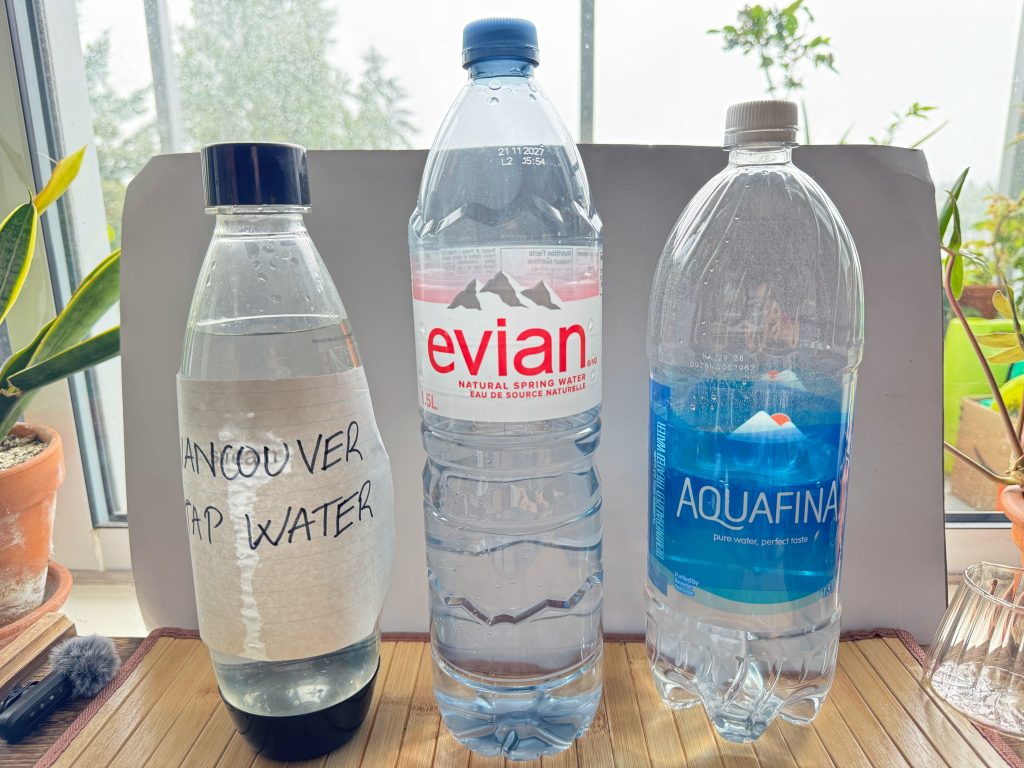
These three were chosen because they carry very different amounts of dissolved minerals. The figures come from the bottle labels and the city’s water report.
Aquafina is purified water: it starts as tap water and is filtered until almost all the minerals are taken out, leaving very little behind [4], so it is close to mineral-free.
Vancouver tap water is very soft. It comes from mountain reservoirs fed by rain and snowmelt, so it picks up very little mineral on the way — only a few milligrams per litre [5]. It also has chlorine, which is used for water treatment.
Evian is natural spring water, and by far the most mineral-rich of the three: calcium at 80, magnesium at 26, and bicarbonate at 360 milligrams per litre, with its total dissolved mineral content at around 345 [6]. It is considered hard water.
The three cover the range: almost no mineral, very little mineral plus chlorine, and a lot of mineral. If the water makes any difference to the cup, these three should bring it out.
The tea
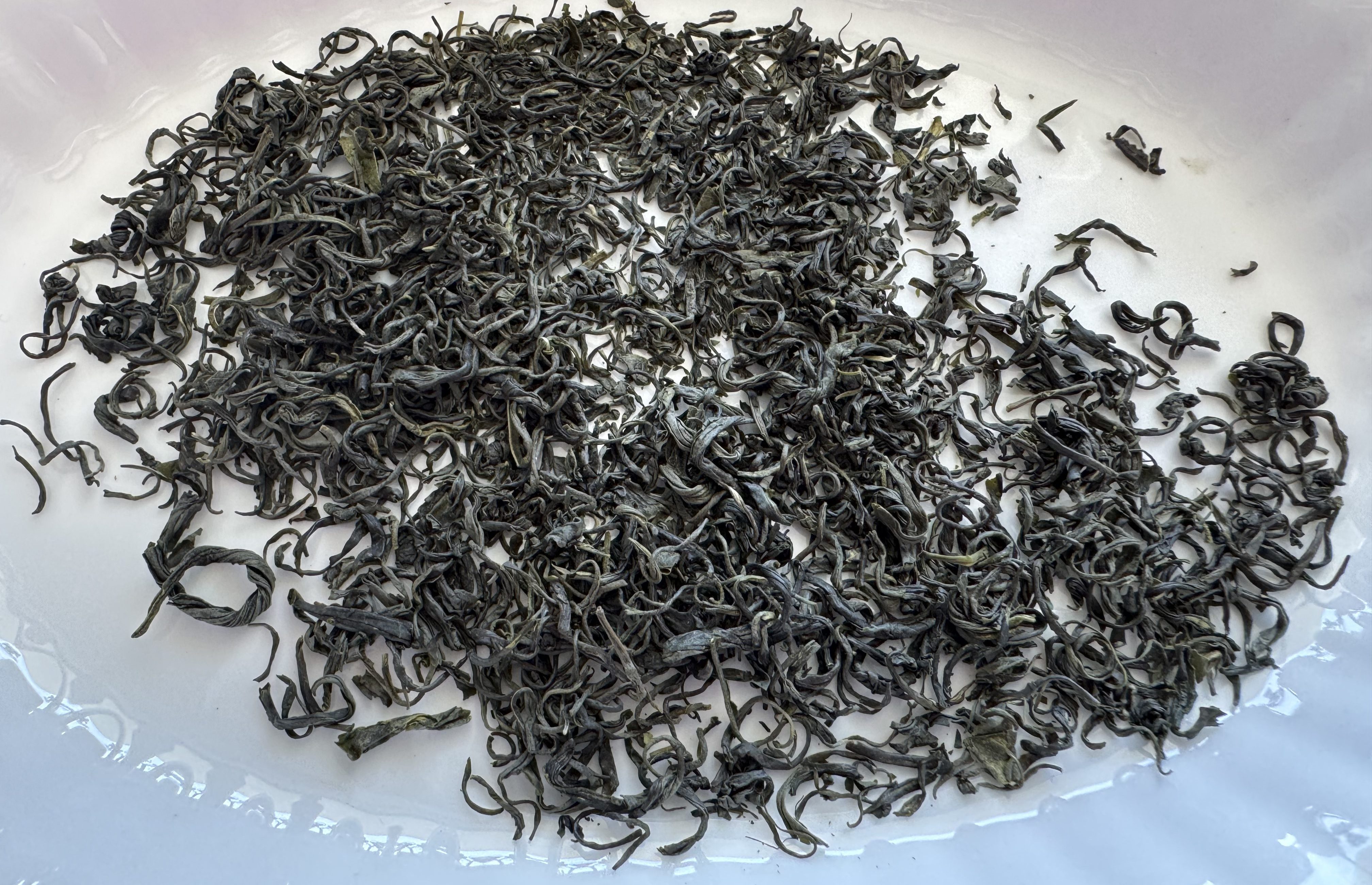
The tea is Trà Đinh Ngọc from the Tân Cương terroir in Thái Nguyên. Also known as needle tea, it is made by selecting only the sharpest, unopened single leaf buds — the needle — before they unfurl [10].
Đinh Ngọc is a good tea for a test like this, for 3 reasons:
- It is made of young buds. Those buds are packed with catechins and other polyphenols — the compounds that give green tea its fresh, brisk, slightly sharp taste [11]. Because these delicate compounds react heavily with minerals dissolved in water, the tea’s flavour profile is highly sensitive to the type of water you use.
- Its aroma is distinctive. The hallmark of a good Tân Cương tea is its scent of young green rice (cốm) [10]. A green tea’s volatile aroma compounds are easily affected by minerals like calcium and bicarbonate [12], making it a perfect indicator for how water chemistry interacts with scent.
- There is nowhere for a change to hide. The tea is light and clean, without the strong roasted notes of a black tea, or the heavy, savory amino acids that an old-growth green tea can carry [13]. If the water chemistry alters the aroma, shifts the first sip, or impacts the sweet aftertaste, there are no heavy, dominating flavors in the cup to cover it up.
What the research suggests
From published research, it appears that the more dissolved minerals a water carries, the more it gets in the way of the tea. In a mineral-heavy water like Evian, the bicarbonate makes the brew slightly alkaline and binds to the tea’s polyphenols, so less of them are drawn out, and the brighter notes are dulled [7]. The calcium works the same way, drawing out less of the flavour, and calcium and bicarbonate together can leave the thin film sometimes seen on a cooling cup [8]. A water with almost no minerals, like Aquafina, does the opposite: it pulls the most out of the leaves, because there is nothing in the way [9].
For the three waters, that gives three predictions:
- Aquafina, with almost no minerals, should pull the most out of the tea — the briskest, sharpest cup, or, with nothing in the water to give it body, perhaps a little thin and flat.
- Evian, high in calcium and bicarbonate, should do the opposite: a softer, flatter cup with the bright notes turned down, and perhaps a faint film.
- Vancouver tap has few minerals, so it may end up very similar to the taste of Aquafina.
The Experiment
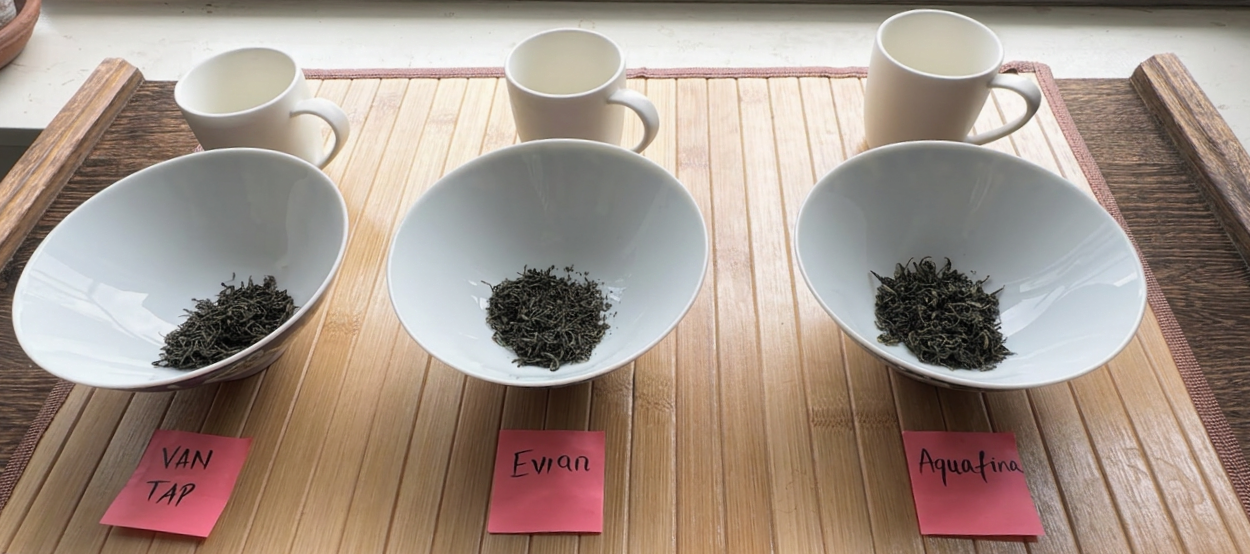
The tea: Trà Đinh Ngọc, a single-bud green from Tân Cương, Thái Nguyên.
The water: Vancouver tap (very soft, chlorine removed with a Brita filter) [5]; Aquafina (purified by reverse osmosis, near mineral-free) [4]; Evian (mineralised spring water — calcium 80, magnesium 26, bicarbonate 360 mg/L) [6].
The brewing: 3g tea – 55ml water, brewed at 180F (~82.2C) for 2 minutes. As I was the only person doing it in my home, I brewed one after another and left them to cool to the same point before tasting.
The methodology: To keep my expectations out of it, the cups were poured, labelled on the base, and their order on the tea table reshuffled, so that I did not know which tea I was tasting until I rewatched the recording. Between each cup, I cleaned my palate with water. For each cup I wrote down aroma, colour and taste.
The Tasting
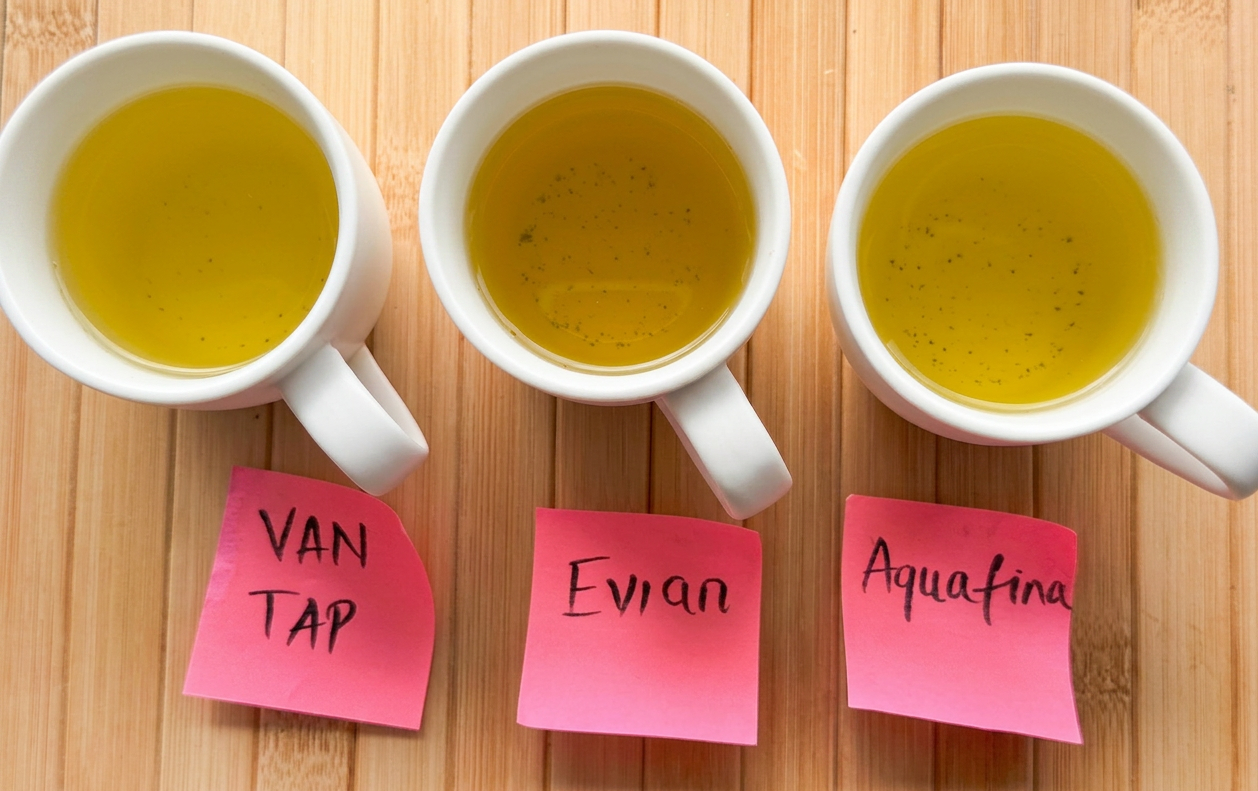
Vancouver Tap Water
- Aroma: The young-rice hương cốm came through gently, faint but clean.
- Colour: The brightest of the three, a clear lime green.
- Taste: On the tongue, it was the most balanced and well-rounded of the set. It went down smoothly, with low bitterness and a long lingering sweetness in the aftertaste. For the body, it had a moderate mouthfeel.
Aquafina
- Aroma: The young rice aroma came through strongly and cleanly.
- Colour: A bright lime green, just a little bit less bright than the tap water.
- Taste: Strongly savoury and smooth. It hit you immediately with the savouriness, but it went down the throat smoothly with low bitterness. This tea didn’t have a full body, and it felt a bit thin in the mouth.
Evian
- Aroma: Dull scent – the young rice aroma was barely there.
- Colour: Dark, deep and murkier yellow-green – see image above
- Taste: It tasted bitter and wasn’t as smooth. It had a fuller body and thicker mouthfeel. However, this was the final cup, and I can’t be sure the bitterness belongs to the water rather than to the tasting catching up with my palate. It was more likely palate fatigue, so see caveats for this.
My conclusion
The water used does influence the taste of the tea. In this case, the Aquafina yielded the most savoury and distinctive cup. Vancouver tap water followed closely, giving a more balanced result that held the savouriness and sweetness together with a muted bitterness. The Evian yielded the darkest colour, a duller aroma and a more bitter cup, though it did have a fuller mouthfeel than the other two.
Some caveats
This was done at home, with one person doing all the brewing and tasting in a single afternoon. I tried to keep everything consistent, but mistakes and biases were inevitable.
The most obvious limitation was that the cups were tasted in succession, with the Evian last: by the time I reached it, astringency had already built up in my mouth and was amplified there. Because of that accumulation, it was hard to tell whether the bitterness came from the water or just palate fatigue. Interestingly, while the Evian felt like it had the “thickest” body, it might have been a bit of a trick; hard water actually holds back the tea’s flavours rather than drawing them out. What I was likely feeling was just the heavy, chalky weight of the mineral water itself, rather than a bolder brew.
It is also worth noting that a high-quality needle tea might have been too sensitive a choice for this experiment. Because it is made entirely of young buds, it packs a concentrated punch. While it started out clean, those intense, crisp flavours quickly built up in my mouth, making the final cups taste a bit overwhelming and sharp. Next time, to keep palate fatigue at bay, I would use a different style altogether—like a Japanese sencha. Because sencha is steamed rather than pan-fired, its profile tends to be much less punchy, brisk, and sharp, allowing for a smoother, more palate-friendly comparison across multiple cups.
Personal preference
I lean towards the Vancouver tap water for its balance and well-roundedness as much as its cost. Aquafina was CA$3.79 and Evian CA$4.79 for a 1.5-litre bottle, while the tap water is essentially free. Thus, even though Aquafina produced the savouriest cup, it was so close to the tap water that I cannot justify buying it, given the amount of tea I drink. For anyone living where the tap water is not drinkable, though, the Aquafina would be a good choice as it can reveal the most honest taste of the tea — and it is cheaper than the Evian.
References
- Nguyễn Tuân, writing on dew-water for tea. To be confirmed against the Vietnamese original, likely Vang bóng một thời (1940).
- Lu Yu, Cha Jing (Classic of Tea), c. 760 CE, chapter 5.
- “Comparing Top Bottled Water Brands: TDS Levels,” DowneLink; FineWaters, “Minerality (TDS).” (Aquafina as reverse-osmosis purified water, very low total dissolved solids.)
- Metro Vancouver, Water Quality Annual Report; regional water-hardness figures for the Capilano, Seymour and Coquitlam supply.
- evian, “Water Quality,” evian.com (label mineral analysis).
- “The Effect of Water Mineralization on the Extraction of Active Compounds from Selected Herbs,” PMC, 2021.
- Franks et al., “The Influence of Water Composition on Flavor and Nutrient Extraction in Green and Black Tea,” Nutrients, 2019; “Tea film formation in artificial tap water,” PMC, 2023.
- Mossion et al., “Effect of water composition on the extraction of compounds in tea infusions.”
- Vietnamese trade descriptions of Trà Đinh Ngọc: “Trà đinh là gì?”, Diễn đàn Marketing; Lộc Tân Cương, “Trà Đinh Thái Nguyên.” (Single-bud — một tôm — plucking standard, needle shape, and the characteristic hương cốm aroma of Tân Cương. Trade sources, consistent with firsthand knowledge.)
- “Correlation between leaf age, shade levels, and characteristic beneficial natural constituents of tea (Camellia sinensis) grown in Hawaii,” Food Chemistry, 2012 (HPLC comparison of catechins and caffeine in the bud, first and second leaf).
- Liu et al., “The types of brewing water affect tea infusion flavor by changing the tea mineral dissolution,” Food Chemistry: X, 2023, PMC 10192933. (Mineral content and pH were the main factors affecting volatile compounds in green tea; calcium notably altered the aroma compounds.)
- Lin et al., “HPLC and high-throughput sequencing revealed higher tea-leaves quality, soil fertility and microbial community diversity in ancient tea plantations compared with modern tea plantations,” 2022, PMC 9097118. (Ancient-plantation leaves significantly higher in free amino acids. Note: the further claim that old trees draw heavier minerals from wild soil via deep roots is largely a trade claim, not established here.)


